Permits & Placement
Protecting Your Driveway During Dumpster Delivery
How to protect a Reading or Berks County driveway from a roll-off dumpster: board placement, weight distribution on older concrete or asphalt, winter freeze-thaw risk, truck clearance, and curb placement when there's no driveway.
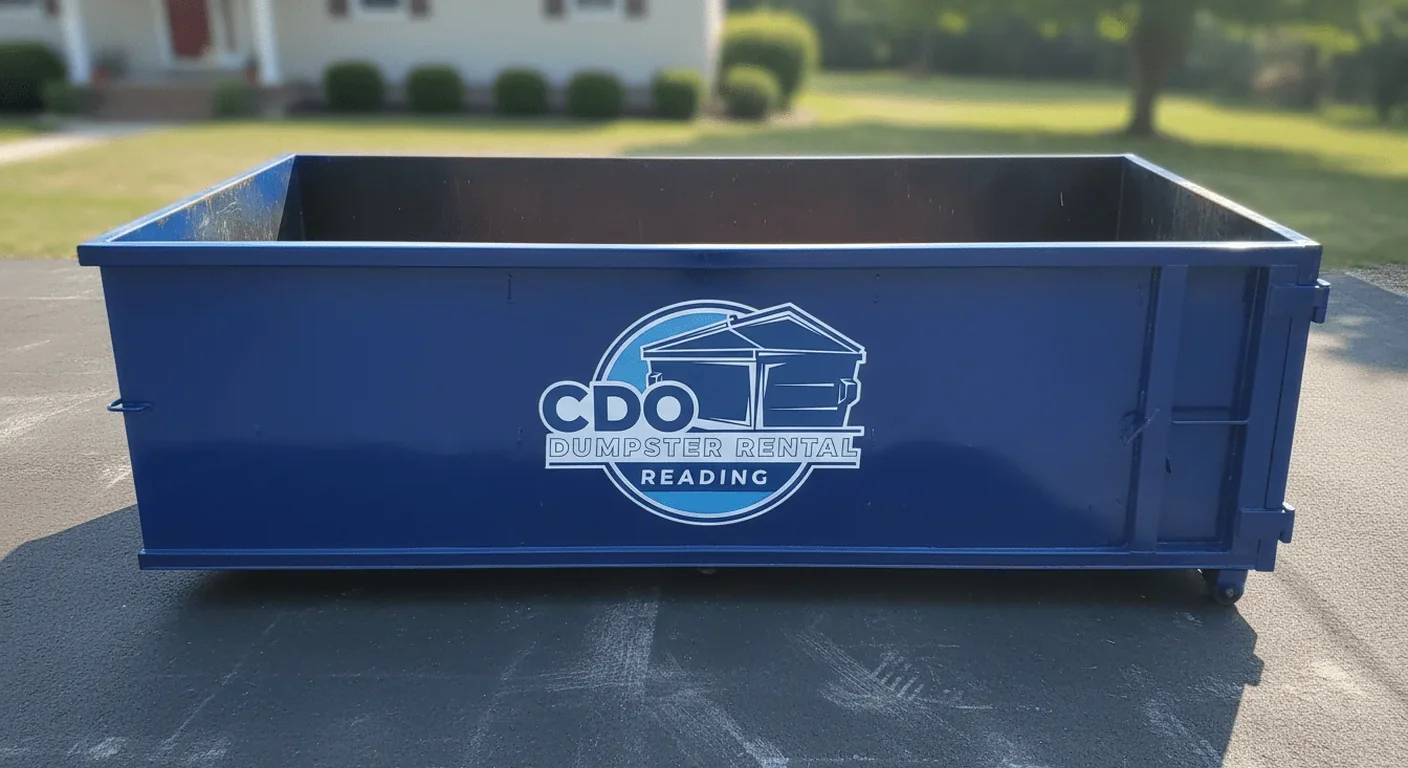
A roll-off dumpster is a heavy piece of steel sitting on rails, and the delivery truck that sets it down is heavier still. On a wide, newly poured driveway that's rarely a problem. On the kind of driveway you'll find in a lot of Reading neighborhoods — a narrow rowhome apron poured decades ago, a hillside slab on Mount Penn or Neversink Mountain, or a farmhouse driveway out in the county that's seen forty winters of freeze-thaw — it's worth thinking through before the truck ever shows up. This guide covers how we protect driveways during delivery and pickup, what makes older Berks County concrete and asphalt more vulnerable, why Pennsylvania winters raise the stakes, how much room the truck actually needs, and what your options are if you don't have a driveway at all.
Why Driveway Protection Matters
A loaded 20 or 30 yard dumpster, plus the truck's own weight on a small footprint of steel rails or tires, concentrates a lot of pressure into a small area. Concrete and asphalt are built to handle distributed loads — a parked car spread across four tires — not a narrow steel rail pressing down in one line for the twenty or thirty minutes it takes to set the container or a truck's rear wheels bearing down while it winches a full container up onto the bed. Cracking, chipping, or surface gouging is the usual result when a driveway isn't protected, and it's almost always avoidable.
We size and place every container with the driveway's condition in mind, and we're happy to talk through placement before delivery day if you have concerns. Call us at (484) 334-4904 and we'll walk your specific driveway through it with you.
Plywood and Board Placement Under the Container Rails
The most effective, lowest-cost protection is simple: heavy boards or plywood sheets laid down where the container's steel rails and the delivery truck's rear wheels will actually sit. A few things make this work well:
- Use thick enough material. Half-inch plywood flexes and can still transmit a point load through to a weak spot underneath. Three-quarter-inch or thicker plywood, or 2x10/2x12 lumber laid side by side, spreads the load much more evenly.
- Cover the full contact length. The rails run the length of the container, so the boards need to run that same length — a short board under just the front edge leaves the rest of the rail resting directly on bare concrete or asphalt.
- Overlap seams, don't butt them. If you're using multiple sheets, overlap the edges slightly so there's no gap the rail can settle into.
- Account for the truck, not just the container. The truck's tires and hydraulic tilt frame put weight on the driveway too, especially during pickup when the container is loaded and heavier than it was on delivery day.
If you're renting a larger container — our 30 yard or 40 yard roll-offs in particular — boards under the rails matter even more, since more debris means more concentrated weight sitting in one spot for the full rental period. If you're not sure which size fits your project and driveway, our dumpster size guide breaks down footprint and typical use by size, or you can just call and describe the job.
Weight Distribution on Older Concrete and Asphalt
Reading's housing stock skews old. Dense brick rowhomes climb the hillside streets on Mount Penn and Neversink Mountain, and plenty of driveways and aprons in the city and older boroughs date back decades, often poured before modern reinforcement standards or rebar spacing became routine. Out in the county, older stone farmhouses often have gravel or thin, patched asphalt drives rather than a full structural slab. None of that means you can't rent a dumpster — it just means the placement decision matters more.
A few patterns we watch for on older Reading-area driveways:
Cracked or Sectioned Concrete
Existing cracks are weak points. A rail or tire resting directly over a crack, rather than spanning it, concentrates stress exactly where the slab is already compromised. Boards that bridge across the crack — rather than boards that happen to end right at it — spread the load to the sound concrete on either side.
Thin or Alligatored Asphalt
Older asphalt that's starting to alligator-crack (a web of interconnected cracks) has usually lost some of its base support underneath. Asphalt is also temperature-sensitive: it softens in summer heat, which can make it more prone to rutting or indentation under sustained point loads, and it gets brittle and more crack-prone in cold weather.
Narrow Rowhome Aprons
A lot of city driveways were built for one car, not a roll-off truck's tandem rear axle. On these tighter aprons, we look at whether the container fits with rails resting on the strongest part of the pad, sometimes angling placement so the load lines up with a support beam or the thicker section of the slab rather than the thin edge nearest the sidewalk.
If your driveway has visible cracking, settling, or you're just not sure it can take the weight, mention it when you book. We'd rather adjust placement — or recommend curb placement instead — than have you deal with new damage.
Winter and Freeze-Thaw Vulnerability in Pennsylvania
This is one area where Berks County is genuinely different from warmer-climate markets. Pennsylvania gets real winters — cold snaps, nor'easters, and a real spring thaw — and that freeze-thaw cycle is hard on concrete and asphalt even without a dumpster involved. Water gets into hairline cracks and pore spaces, freezes, expands, and widens the crack a little more each cycle. A driveway that looks fine in July can be noticeably more brittle by February.
Cold weather changes the risk profile in a few specific ways:
| Season | Driveway condition | What we watch for |
|---|---|---|
| Winter (frozen ground) | Concrete and asphalt become more brittle; ice can hide surface cracks | Extra board coverage; clearing ice/snow from the placement spot before drop-off |
| Early spring (thaw) | Saturated sub-base underneath the slab is softer and less supportive | Avoiding placement directly after heavy rain or rapid snowmelt when possible |
| Summer (heat) | Asphalt softens and is more prone to indentation under sustained weight | Boards spread the load; shorter dwell time in direct sun where feasible |
| Fall | Generally the most stable, driest, moderate-temperature condition | Standard board placement is usually sufficient |
If you're planning a winter cleanout or a project that will run into freezing weather, it's worth reading our Pennsylvania seasonal cleanup guide for more on timing deliveries around weather. We still deliver and pick up through winter — we just factor snow, ice, and a frozen or thawing sub-base into where exactly the container sits.
Clearance the Delivery Truck Needs
Beyond what's under the container, we also need enough room to get the truck in, positioned, and back out safely. A few clearance points that matter on Reading-area properties:
- Overhead clearance. The truck's bed tilts up to load and unload the container, which needs vertical room above the driveway. Low tree limbs, power lines, carport roofs, and porch overhangs common on older city lots all factor in.
- Approach width and turning radius. Narrow rowhome streets, sharp driveway aprons, and tight alleys can make a straight backing approach difficult. We may ask about street width or nearby parking when scheduling.
- Length of the drop zone. The container itself needs a clear, mostly level stretch at least as long as the unit, plus room behind it for the truck to maneuver during placement and again during pickup.
- Curbside obstacles. Parked cars, trash cans, low fences, and steep curb cuts can all affect where the truck can safely position for delivery.
If your property is on one of Reading's steeper hillside streets or a tight downtown block, mention that when you book — call (484) 334-4904 and describe the street and driveway, and we'll figure out the right approach and container size together. Same-day options are available for straightforward jobs; see our same-day dumpster rental page for details.
No Driveway? Curb and Street Placement
Not every property in Reading or Berks County has a driveway that works for a roll-off — some rowhomes have none at all, and some older lots have a driveway too narrow or too cracked to risk it. Curb or street placement is a normal alternative, but it comes with its own considerations:
Permits for Public Street Placement
Placing a dumpster on private property — your driveway, a construction site, a parking area — doesn't require a permit. Placing one on a public street, however, generally does. Requirements vary by municipality, so it's worth confirming with the City of Reading, your local borough or township, or Berks County before the container arrives. We cover this in more detail in our dumpster permits in Reading, PA guide, including what most municipalities want to see on a permit application.
Right-of-Way and Road Weight Considerations
Street placement also means the container sits within the public right-of-way, which is regulated at the state level by the Pennsylvania Department of Transportation (PennDOT) for state-maintained roads, in addition to whatever your municipality requires. Reflective markers or cones are often required so the container is visible to traffic, particularly at night, and it needs to sit clear of storm drains, fire hydrants, and marked travel lanes.
Practical Curb Placement Tips
- Boards still help on a curb strip or paved shoulder, especially if it's older patched asphalt.
- Placement usually needs to avoid blocking mail delivery, trash pickup, and neighboring driveways.
- Street placement is typically time-limited under most local permits, so it lines up well with our standard rental period rather than an open-ended stay.
We deliver to driveways, curbs, construction sites, and parking areas throughout Reading and the surrounding Berks County communities, and we'll help you figure out which placement makes sense for your property. If you're not sure whether your situation needs a street permit, call us at (484) 334-4904 before you book and we'll point you in the right direction.
What We Do on Delivery Day
Our driver looks at the actual surface before setting the container down — not just the address on the work order. That means checking for existing cracks, confirming there's enough clearance for the truck's tilt frame, and placing protective boards under the rails as a standard part of delivery, not an upsell. If something about your driveway looks like it needs extra care — a steep grade, a section that's clearly settled, ice that hasn't been cleared — we'll talk it through with you on the spot rather than just dropping the container and leaving.
The same care applies at pickup. A full container is heavier than an empty one, so we check placement again before winching it back onto the truck, especially after several days of Pennsylvania weather have had a chance to work on the driveway underneath.
A Quick Reference: Surface Type and Protection Needed
| Surface type | Typical risk | Recommended approach |
|---|---|---|
| Newer poured concrete, no visible cracks | Low | Standard board placement under rails |
| Older concrete (pre-existing cracks or sections) | Moderate to high | Boards positioned to bridge cracks; discuss placement in advance |
| Asphalt, good condition | Low to moderate | Standard boards; avoid peak summer heat placement where possible |
| Asphalt, alligator-cracked or patched | High | Extra board coverage or consider curb placement |
| Gravel or paver driveway | Moderate | Boards to prevent rutting or shifted pavers |
| No usable driveway | N/A | Curb or street placement, permit as required |
Talk to Us Before Delivery Day
Every driveway in Reading and Berks County is a little different — a hillside rowhome apron near the Pagoda is not the same as a farmhouse gravel lane out toward Womelsdorf or a newer subdivision drive in Wyomissing. The fastest way to make sure your dumpster delivery goes smoothly is to tell us about your driveway when you book: its age, any cracking you've noticed, how it slopes, and whether there's a tight approach from the street. Call (484) 334-4904 and we'll size the container and plan placement around your specific property, with flat-rate pricing that covers delivery, pickup, and disposal. You can also browse our roll-off dumpster rental page or our full services list to see what fits your project before you call.
Need a container in Reading or anywhere in Berks County? Call (484) 334-4904 and describe the job. We will name the size, the flat rate and a delivery slot — often the same day. No forms, no waiting on an email.